Somerset & Dorset Property Market: Q3 2026 Update
The short version
Asking prices in the South West fell by £14,800 this year, the biggest drop of any region in the UK. That single number tells you most of what you need to know about selling in Somerset and Dorset right now: buyers have choice, they are watching every pound, and homes priced on hope are sitting.
The latest national market report from TwentyCi, which tracks 99.6% of UK property sales and rentals, landed this week. We have read all 50-odd pages so you don’t have to. Here are the five findings that matter most to West Country homeowners, and our straight take on each.
1. More homes for sale than at any point in a decade
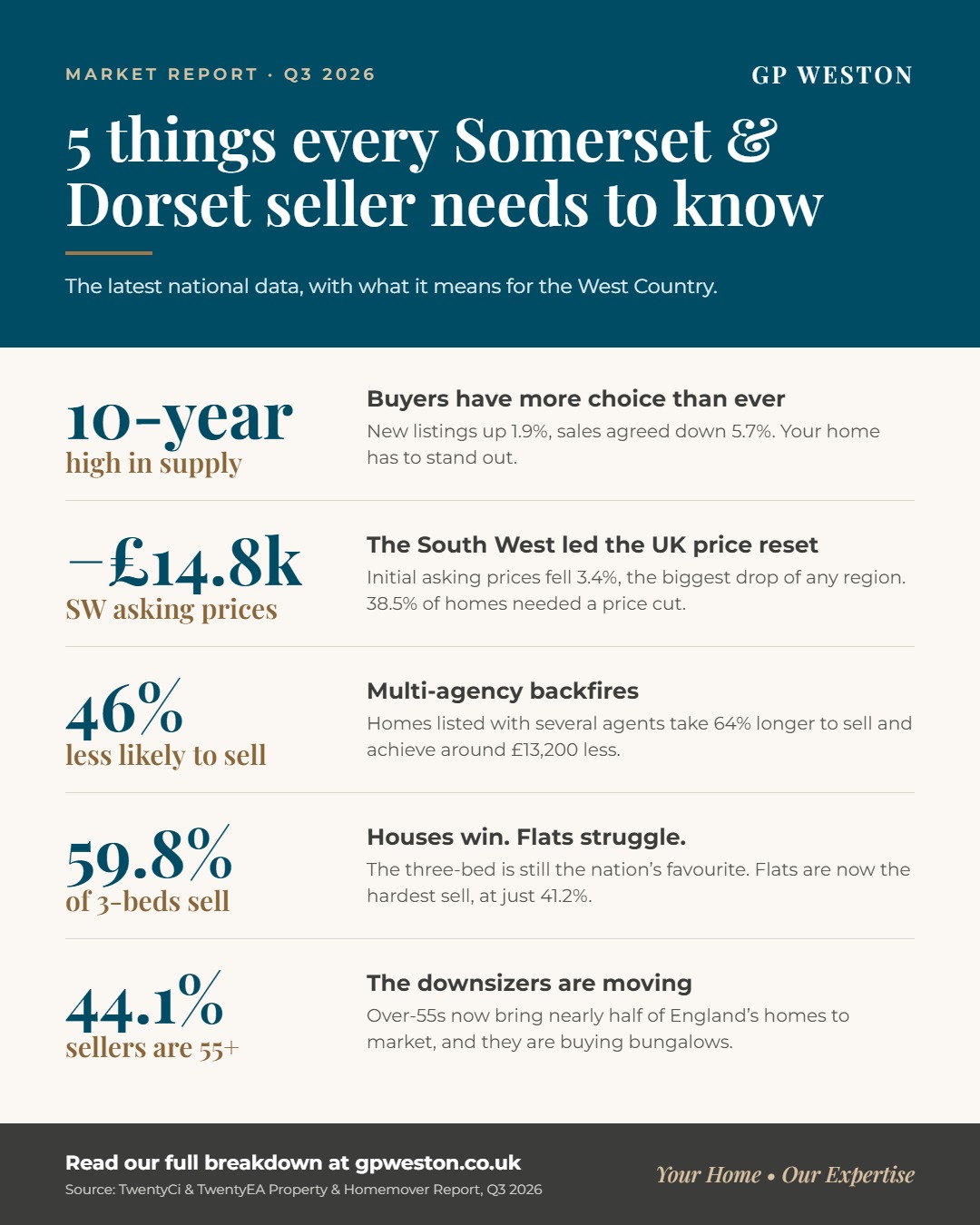
New listings are up 1.9% on last year, the highest level in ten years. Over the same period, sales agreed are down 5.7%. More stock, fewer buyers.
What it means here: every buyer looking in Somerset and Dorset has more options than they have had in years. Your home is not competing with the market. It is competing with the three similar homes on the same Rightmove search. Presentation, photography and the first two weeks of marketing matter more than they have for a long time.
2. The South West led the UK price reset
Initial asking prices in the South West fell by £14,800, or 3.4%, the steepest fall of any UK region. Nationally, 38.5% of homes that came off the market this year needed at least one price reduction.
What it means here: sellers and agents in our region are starting to price realistically, and that is healthy. The risk is the seller who lists at last year’s number. A reduction after six weeks rarely recovers the lost momentum. Price it right on day one and you lead the market instead of chasing it down.
3. Multi-agency costs sellers time and money
Compared with homes listed with a single agent, homes marketed by several agents were:
- 46% less likely to sell
- 64% slower to find a buyer
- 56% more likely to need a price reduction
- sold for around 3% less, about £13,200 on an average home
What it means here: more boards outside does not mean more buyers. To a buyer, the same house on several agents’ websites looks like a house nobody wants. Multi-agency fees also tend to be higher. One agent, one asking price and one clear plan wins on every measure the report tracked.
4. Houses are winning, flats are struggling
Three-bedroom homes have the best chance of selling of any size, at 59.8%. Detached houses have become easier to sell, rising to a 50% likelihood this year. Flats are now the hardest property type to sell, at 41.2%, down from 54.2% in 2022.
What it means here: good news for owners of family houses across Somerset and Dorset, where buyers want space and gardens. If you own a flat, especially a leasehold one, have your lease length, service charges and management pack ready before you list. Buyers are nervous about leasehold surprises, and answers up front keep sales together.
5. The downsizers are on the move
Over-55s now bring 44.1% of England’s homes to market, up from 37.5% before the pandemic. Homeowners aged 55 to 64 typically sell a home worth 8.8% more than the one they buy. Bungalows make up a 19% larger share of what they buy than of what they sell.
What it means here: the West Country is a natural home for this move. If you own a well-kept bungalow or a smaller home in a village with a shop and a bus route, you have exactly what this group is looking for. If you are thinking of downsizing yourself, there is a steady supply of buyers for the family home you are leaving.
What this means if you’re selling in Somerset or Dorset
This is not a market to panic about. Transactions are still well above 2023 and 2024 levels, fewer sales are falling through, and prices nationally are up around 1% on last year. It is a market that rewards honest pricing and proper marketing, and punishes guesswork.
If you are thinking of moving in the next six months:
- Get a valuation grounded in evidence, not the highest number you hear. Ask any agent to show you the recent sales and live competition behind their figure.
- Choose one agent and give them a clear brief. The data on multi-agency is about as clear as property data gets.
- Launch properly. The first fortnight is when buyer interest peaks. Professional photography, a floorplan and a well-presented home earn their cost many times over.
- Have your paperwork ready. Sales now take around four months from offer to exchange. Anything you can prepare before listing shortens that wait.
We are an independent, owner-run agency covering Somerset and Dorset, and we will tell you straight what your home is worth in this market and how we would sell it. Book a free valuation or call us for a no-obligation chat.
Frequently asked questions
Are house prices falling in Somerset and Dorset?
Asking prices have softened. Initial asking prices across the South West fell 3.4% in 2026, the largest fall of any UK region. Achieved prices nationally are still around 1% higher than a year ago, so the gap is mostly sellers adjusting expectations rather than a crash.
How long does it take to sell a house in 2026?
On average, 75 days to agree a sale and a further 127 days, about 4.2 months, from sale agreed to exchange. From listing to keys, a typical move now takes around seven months.
Is it better to use one estate agent or several?
One. Across the UK, homes listed with several agents were 46% less likely to sell, took 64% longer and achieved about 3% less than homes listed with a single agent.
What type of property sells best right now?
Three-bedroom homes have the highest chance of selling, at 59.8%. Detached and semi-detached houses are getting easier to sell, while flats are now the hardest property type to shift.
Is now a good time to sell?
It is a good time to sell if you price realistically. Supply is high, so buyers compare carefully, but fewer sales are falling through than last year. A well-priced, well-presented home still sells.
Source
All figures are from the TwentyCi & TwentyEA Property & Homemover Report, Q3 2026, covering UK sales and lettings data for January to September 2026. Regional figures refer to the South West region as a whole. Commentary and local interpretation are GP Weston’s own.